

My Investing tips for the Calgary Market
The 5 Pillars of a Successful Calgary Investment Property
Not every property is an investment property.
In Calgary, investors have plenty of choices—but the difference between simply owning real estate and building long-term wealth through real estate often comes down to what you buy, where you buy it, and how you structure the investment.
After years of investing in Calgary and working with buyers and sellers, I've found that the strongest residential investments tend to share five characteristics.
1. Location That Protects Your Tenant Demand
The first question I ask isn't "How much could this property appreciate?"
It's "Who is going to want to live here—and why?"
Properties close to major employment centres, transit, schools, shopping, recreation and transportation corridors generally have a much deeper pool of potential tenants.
In Calgary, that can mean proximity to the downtown core, major employment nodes, hospitals, post-secondary institutions, industrial areas and major transportation routes.
The goal isn't simply to buy a property in a "good neighbourhood." It's to buy in a location where people have a reason to live.
A strong location can help support occupancy, rental demand and resale value through different stages of the market cycle.
2. Multiple Income Streams & Future Flexibility
One of my favourite characteristics in a Calgary investment property is flexibility.
A property that can accommodate a legal secondary suite, an appropriate garden suite, or another permitted income-producing configuration can potentially create significantly more value than a property that can only generate one rental income stream.
But there's an important distinction:
Don't buy a property simply because someone tells you it "could be suited."
Investigate the zoning, permitting, construction requirements, parking, separate entrances, fire and life-safety requirements, and the economics of actually creating the additional unit.
The best investment properties often have multiple ways to win.
If rents rise, you benefit from increased income.
If you renovate, you may increase the property's value.
If your circumstances change, a flexible property may give you additional options for how you use or rent the asset.
3. Use Leverage—But Respect It
Leverage is one of the most powerful tools available to a real-estate investor.
For example, an investor who purchases a $600,000 property with $120,000 of equity is controlling a $600,000 asset—not a $120,000 asset.
If the property increases in value, the increase is based on the entire property's value, not simply the original equity invested.
That's where leverage can dramatically increase the return on invested capital.
But leverage works both ways.
Higher interest rates, vacancies, unexpected repairs or declining property values can magnify losses just as quickly as leverage can magnify gains.
The objective isn't to borrow as much as possible. It's to use debt strategically while maintaining enough financial flexibility to survive the inevitable bumps in the market.
4. Buy Where the Next Wave of Demand Is Coming From
Historical appreciation is useful—but it shouldn't be the only thing you look at.
I want to know what is happening around the property today and what is likely to happen over the next 5–10 years.
That means looking beyond the house itself.
Are new communities being developed nearby?
Are schools, retail, recreation or employment centres being added?
Is transportation infrastructure improving?
Is the area experiencing population growth?
Are established communities undergoing redevelopment or intensification?
These factors can change the demand profile of an area over time.
You're not just buying today's property. You're buying its future position within Calgary.
5. Make the Numbers Work Before You Buy
This may be the most important pillar of all.
Don't fall in love with the property before you fall in love with the numbers.
A property can look inexpensive, have a great location and appear to have tremendous appreciation potential—and still be a poor investment.
Before purchasing, I recommend modelling:
- Mortgage payments and financing costs
- Property taxes
- Insurance
- Condo fees, where applicable
- Utilities paid by the owner
- Maintenance and capital expenditures
- Property management
- Vacancy and turnover
- Leasing costs
- Expected rental income
- Future financing scenarios
- Potential renovation or suite costs
And don't simply model the best-case scenario.
Ask yourself:
What happens if the property is vacant for a month?
What happens if the furnace fails?
What happens if interest rates increase when I refinance?
What happens if rents don't increase as quickly as expected?
A great investment isn't one that only works when everything goes right.
A great investment is one that remains manageable when something goes wrong.
The Investor's Checklist
| Pillar | What I'm Looking For |
|---|---|
| 1. Location | Employment, transit, schools, amenities and long-term tenant demand |
| 2. Flexibility | Legal suites, additional income potential and adaptable property configuration |
| 3. Leverage | Sensible financing that accelerates equity growth without overextending the investor |
| 4. Future Growth | Infrastructure, population growth, development and neighbourhood transformation |
| 5. Numbers | Conservative cash-flow projections, realistic expenses and stress testing |
The Bottom Line
There is no single "perfect" Calgary investment property.
The best opportunity depends on your capital, financing, investment horizon, risk tolerance and objectives.
But whether you're buying your first rental property or your fifth, I believe the same principle applies:
Buy the property based on the numbers and fundamentals—not the emotion of the purchase.
Calgary continues to offer interesting opportunities for residential investors, but finding them requires looking deeper than the listing price or projected appreciation.
If you're considering purchasing an investment property in Calgary, I'd be happy to help you analyze the opportunity before you make an offer.
Sometimes the most valuable advice an investor can receive is knowing which property not to buy.


Mckenzie Lake: One of Calgary's top Lake Communities and best kept secrets
There are a handful of communities in Calgary where the neighbourhood itself becomes part of the reason people stay for decades. McKenzie Lake is one of them. Tucked into the far southeast against the edge of Fish Creek Provincial Park, it's built around a private lake that residents actually use — not just look at from a distance — and it consistently ranks among the city's most sought-after family communities.
The Lake Is the Whole Point
McKenzie Lake's defining feature is exactly what the name promises: a private, spring-fed lake and island at the centre of the community, developed in the early 1980s in the same tradition as Lake Bonavista. Residents with lake access get a genuinely rare setup for a Canadian city — swimming, fishing, and boating through the summer, a groomed skating surface, illuminated hockey rinks, and fire pits around the lake once winter sets in. The lake is stocked with rainbow trout during certain months, and there's a Beach Club facility available for member rentals year-round.
One important detail if you're house-hunting here: not every property inside the community boundary has lake access. The access boundary is separate from the community boundary, so if lake privileges matter to you, that's something to confirm on any specific listing before you fall in love with it.
Location and What It Means for Your Commute
McKenzie Lake sits in the far southeast, bordered by Deerfoot Trail to the east, Stoney Trail to the south, 130 Avenue SE to the north, and Fish Creek Provincial Park along the entire western edge. That last part is the real luxury here — one border of the community backs directly onto one of the largest urban parks in North America, with over 100 km of trails, rather than more subdivision.
The Deerfoot/Stoney Trail intersection puts you within reach of most of the city in a hurry, and Stoney Trail gives you a fast, uncomplicated run west to the mountains on your days off. It's a genuinely established, low-turnover community.
What the Streets Actually Look Like
McKenzie Lake is a mix of original 1980s and '90s bungalows and two-storeys alongside newer infill, with the most dramatic homes lining the ridge overlooking the lake and the waterfront itself — multimillion-dollar properties are not unusual on those stretches. Away from the water, you'll find a wide range of well-kept family homes, many originally built for the acreage-adjacent, semi-rural feel the developers were going for when the area was first annexed into the city in 1970.
Schools in the community include McKenzie Lake School (K–6) and Blessed Cardinal Newman School (K–9), with Bishop O'Byrne High School nearby — a real factor if you're moving with kids already in the system.
What's on the Market Right Now
As of June 19, 2026, there were 21 active listings in McKenzie Lake, with an average asking price of $753,305 and prices ranging up to $1,300,000. Average price per square foot sat around $413, on homes averaging roughly 1,857 square feet with close to 4 bedrooms and 3+ bathrooms. Separately, detached-home data for the twelve months ending June 30, 2026 showed homes selling in a median of just 16 days, with inventory sitting under one month — a clear seller's market for well-presented properties.
That combination — tight inventory and quick sales means timing and preparation matter more here than in a lot of other Calgary communities. Homes that are priced and presented well tend to go fast.
Why I Point Clients Toward McKenzie Lake
McKenzie Lake is the kind of community where your kids can walk to the lake in the summer or go for a walk/bike ride in Fish Creek, and where coming home actually feels like leaving work behind. It features schools and easy access to the 130 Avenue SE amenities.
If lake access, a strong school lineup, and direct proximity to Fish Creek Park sound like what your family's next chapter needs, I'd be glad to walk you through what's currently available — and help you understand exactly which properties come with lake privileges before you get attached to one that doesn't.
Thinking about buying or selling in McKenzie Lake? Reach out and let's have a straightforward conversation about what fits your family and your career.

Mckenzie Towne - Small town feel in the big City
A Community Designed the Old-Fashioned Way — On Purpose
McKenzie Towne was launched in 1995 by Brookfield Residential (then Carma Developers) as one of Calgary's first large-scale experiments in "New Urbanism" — narrow streets, front porches facing the sidewalk, garages tucked into back lanes, and a walkable commercial main street instead of a strip mall. It worked well enough that the Urban Land Institute named it one of the world's 26 most exceptionally planned communities.
What that means in practice: you can walk to a coffee shop, a dentist, a pub, and a grocery store without touching your vehicle. For anyone coming off a night shift who just wants to grab a coffee and decompress on foot, that matters more than people realize.
The Practical Stuff: Location and Commute
McKenzie Towne sits in the southeast, bounded by Deerfoot Trail to the west, Stoney Trail to the south, 52 Street SE to the east, and the South Trail commercial area along 130 Avenue SE to the north. That puts you within a few minutes of two major freeways — which, if you're the one getting called in on short notice, is not a small thing. South Health Campus is about 4 km away, making it a realistic option for hospital staff who want a short, freeway-adjacent commute instead of fighting cross-town traffic.
And here's the detail I like most for this audience: Calgary Fire Station 30 is located right inside McKenzie Towne, on McKenzie Towne Gate SE. It's not every day you get to live in the same community your crew operates out of.
What the Neighbourhood Actually Feels Like
McKenzie Towne breaks down into a few distinct pockets, each with its own architectural personality:
- Elgin — European-inspired streetscapes: English Tudor, Greek Revival, French Eclectic, and Italianate styles.
- Prestwick and Inverness — Queen Anne (Victorian), Craftsman, Georgian, and National Style homes.
- High Street — the community's commercial heart, with street-front shops, cafes, and services designed to be walked to, not driven to.
Add in the ponds, the network of paved pathways, a splash park, an outdoor rink, and McKenzie Towne Hall — which runs community programming and event space through the local residents' association — and you get a neighbourhood that was built for actual daily living, not just curb appeal.
What's on the Market Right Now
As of mid-July 2026, there were 68 active listings in McKenzie Towne, with a median list price around $409,900 and homes averaging 46 days on market. Prices span a wide range — condos start in the low $200,000s, while larger detached homes and estate properties can run past $800,000 — which means there's realistic room here whether you're a first-time buyer , or a more established dual-income household ready to move up.

Buying a New Build in Calgary? Why Representation Matters
New build homes are an attractive option for many Calgary buyers.
You get a brand-new home, modern finishes, current building standards, warranty coverage, and the opportunity to choose layouts, upgrades, colours, and design details. For some buyers, building new can be a great fit.
But before you walk into a showhome or start discussing options with a builder, there is one important thing to understand:
The builder’s sales representative works for the builder. That does not mean they are doing anything wrong. It simply means their role is to represent the builder’s interests, not yours.
A common misconception is that buyers may get a better price by going directly to the builder. In most cases, the price is the same — the difference is whether you have someone representing your interests.
New Builds Are Still Real Estate Transactions
Some buyers assume that purchasing a new build is simpler than buying a resale home. In some ways, the process may feel more straightforward because there is no competing seller living in the home and everything is new.
But new build purchases come with their own set of decisions, details, and risks.
You may need to consider:
- Lot selection
- Floor plan options
- Upgrade costs
- Deposit structure
- Builder contracts
- Possession timelines
- Escalation clauses
- Warranty coverage
- Landscaping and fencing requirements
- Appliance packages
- Basement development options
- Condo or HOA fees, if applicable
- Resale value down the road
These decisions can affect both your short-term budget and your long-term satisfaction with the home.
The Showhome Is Designed to Impress
Showhomes are beautiful for a reason.
They often include upgraded finishes, professional staging, premium lighting, custom features, and design details that may not be included in the base price of the home.
This can make it harder to compare the advertised price to the actual cost of building the home you want.
A buyer representative can help you slow down and look at the full picture, including what is included, what is extra, and how the final price compares to resale options in the area.
Builder Contracts Are Different
Buying from a builder usually involves a different type of contract than purchasing a resale home.
These contracts can include builder-specific terms, timelines, conditions, allowances, and responsibilities. It is important to understand what you are agreeing to before you sign.
A Realtor can help you ask better questions, review the overall structure of the deal, and encourage you to seek legal advice when needed.
The goal is not to create unnecessary obstacles. The goal is to make sure you understand the commitment you are making.
New Build Pricing Should Still Be Compared to the Market
One of the most important steps in buying a new build is comparing it to the broader market.
A new home may look appealing, but buyers should also consider how it compares to similar resale homes nearby. Sometimes a new build offers excellent value. Other times, the cost of upgrades, landscaping, window coverings, appliances, and future development can add up quickly.
It is important to understand the real cost of the home once everything is included.
A good buying strategy should consider:
- The base price
- Upgrade costs
- Lot premiums
- Timeline to possession
- Additional costs after possession
- Comparable resale homes
- Community development plans
- Long-term resale potential
Bring Representation Before You Visit the Showhome
This is important.
If you are thinking about buying a new build, it is best to connect with your Realtor before visiting a showhome or registering with a builder.
Builders may have policies around Realtor representation, and in many cases, your Realtor needs to be involved from the beginning of the process.
If you visit first and register on your own, it may limit your ability to bring in representation later.
A New Build Can Be a Great Choice
This is not about discouraging buyers from purchasing new construction.
For many people, a new build is the right fit. It can offer modern layouts, energy efficiency, customization, and peace of mind. The key is making sure you understand the process and have someone representing your side of the transaction.
Having your own representation can help you ask the right questions, compare options, and make a more confident decision.
The Bottom Line
Buying a new build in Calgary can be exciting, but it is still a major real estate purchase.
Before you walk into a showhome, it is worth having a conversation about your goals, budget, timeline, and the communities you are considering.
That way, you can explore your options with a clear understanding of the process and someone looking out for your interests.
Thinking about buying a new build in Calgary or the surrounding area? Reach out before you visit the showhome so you have representation from the start.
For more buyer tips and monthly Calgary real estate insights, subscribe to my monthly newsletter below.

Buying an Acreage Near Calgary: What You Need to Know
For many buyers, the idea of owning an acreage near Calgary is incredibly appealing.
More space. More privacy. Room for a shop, garden, animals, or simply a quieter lifestyle outside the city. Areas around Calgary, including Rocky View County, Foothills County, Bearspaw, Springbank, De Winton, Bragg Creek, and other surrounding communities, continue to attract buyers who are looking for more than a standard city property.
But buying an acreage is not the same as buying a home in the city.
There are additional layers to consider, and the right guidance can make a big difference.
Acreage Living Is About More Than the House
When you buy a typical city home, the focus is often on the house, the lot, the neighbourhood, and the commute.
With an acreage, the property itself becomes a much bigger part of the decision.
You are not just buying a home. You may also be buying land, access roads, water systems, septic systems, outbuildings, fencing, drainage considerations, and long-term maintenance responsibilities.
Two acreages can look similar online but be completely different once you understand the land, location, services, and future resale potential.
Key Things to Consider Before Buying an Acreage
Before purchasing an acreage near Calgary, it is important to look at the full picture.
Some of the most important considerations include:
- Water source and water quality
- Septic system condition and maintenance
- Zoning and land use
- Road access and winter maintenance
- Internet and cell service
- Outbuildings, shops, barns, or garages
- Drainage and grading
- Property boundaries and easements
- Proximity to schools, services, and commuting routes
- Future resale appeal
These details can have a major impact on your day-to-day life and your long-term investment.
Location Still Matters
One of the biggest mistakes acreage buyers can make is focusing only on the home and land size.
Location still matters.
A beautiful home on a poorly located parcel may not hold value the same way as a well-positioned acreage with strong access, desirable surroundings, and practical amenities nearby.
Buyers should think carefully about commute times, school options, nearby services, road conditions, and how the location may appeal to future buyers as well.
Popular areas around Calgary can vary significantly in price and demand. Properties in highly desirable locations with strong access and usable land can attract consistent interest, while more remote or highly specialized properties may appeal to a smaller buyer pool.
Acreages Can Be Highly Unique
In the city, it is usually easier to compare one home to another. There may be several similar properties nearby that have sold recently.
With acreages, comparable sales can be more complicated.
One property may have mountain views. Another may have a shop. One may be on a paved road, while another is on gravel. One may have a newer septic system, while another may require upgrades. One parcel may be mostly usable land, while another may have slopes, wetlands, or access limitations.
That uniqueness is part of the appeal, but it also means valuation requires a more detailed look.
Sellers Need the Right Strategy Too
If you are selling an acreage, marketing matters.
Acreage buyers are often looking for a specific lifestyle. They want to understand not just the home, but the land, the setting, the privacy, the features, and the possibilities.
Strong acreage marketing should highlight:
- The lifestyle the property offers
- Key land features
- Outbuildings and usable space
- Recent updates or system improvements
- Access to nearby communities
- Commute considerations
- Unique property benefits
Pricing also needs to be carefully considered. Because acreages can vary so much, the right strategy should be based on more than a simple square footage comparison. In the current Calgary-area market, many acreage buyers are becoming more selective. Move-in-ready properties with strong water systems, modern septic setups, usable land, and reliable connectivity are especially appealing, while properties requiring major updates may need to be priced and positioned more carefully.
Why Representation Matters
Whether you are buying or selling, acreage real estate requires a different level of due diligence.
For buyers, that means knowing what questions to ask before writing an offer. For sellers, it means presenting the property in a way that speaks to the right audience and accurately reflects the value of the land, home, and lifestyle.
Acreage transactions often involve details that may not come up in a standard city purchase. Having someone in your corner who understands those differences can help you make a more informed decision.
The Bottom Line
Buying an acreage near Calgary can be an incredible opportunity, but it is important to understand what you are buying.
The house is only one part of the decision. The land, services, location, systems, access, and long-term maintenance all matter.
If you are considering buying or selling an acreage in the Calgary area, I would be happy to help you understand the market, compare your options, and make a confident move.
Thinking about acreage living near Calgary?
For more detailed monthly insights on Calgary, acreage, and surrounding area real estate trends, subscribe to my monthly real estate newsletter.
Reach out anytime for a personalized conversation about your next move, or subscribe below for Market Updates.
Calgary Real Estate Is Not One Market: Why Property Type Matters
When people talk about the Calgary real estate market, it is easy to think of it as one big market moving in one direction.
But the reality is much more specific than that.
What is happening with detached homes may look very different from what is happening with condos. A townhouse in one area may attract strong buyer activity, while an apartment in another area may sit longer than expected. Even within the same city, different property types, price points, and neighbourhoods can behave very differently.
That is why it is so important to look beyond the headlines.
A Quick Look at the Current Numbers
Recent Calgary market data continues to show why property type matters. Detached homes remain comparatively tight, while apartment condominiums are seeing more supply and more buyer choice.
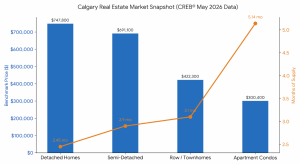
Calgary Real Estate Market Snapshot based on CREB® May 2026 data. Benchmark prices and months of supply vary significantly by property type.
Calgary’s Market Is Becoming More Property-Specific
Recent market activity in Calgary shows that buyers and sellers need to pay attention to the details. Detached homes continue to see healthy demand in many areas, while certain segments of the condo and apartment market are experiencing more inventory and increased buyer choice.
For sellers, this means pricing strategy matters more than ever. A home cannot simply be priced based on what the overall market is doing. It needs to be priced based on its property type, condition, location, competition, and the current level of buyer demand.
For buyers, this creates opportunity, but also the need for careful comparison. Some segments are still competitive, while others may allow more room for negotiation.
Detached Homes Are Still Seeing Strong Demand
Detached homes continue to be an important part of Calgary’s market, especially in areas where inventory remains tighter and buyer demand is steady.
For many families, detached homes remain the preferred option because they offer more space, private yards, garages, and long-term flexibility. These properties can still move quickly when they are well-priced, well-presented, and located in desirable areas.
That does not mean every detached home will sell overnight. Buyers are still paying close attention to condition, upgrades, layout, location, and price. But overall, detached homes continue to hold strong appeal in Calgary.
Condo and Apartment Buyers May Have More Options
The apartment and condo market is a different story.
In some areas, buyers are seeing more choice than they did previously. More inventory can change the feel of the market quickly. When buyers have more options, they tend to compare more carefully and take more time before making a decision.
For sellers in this segment, presentation and pricing are especially important. Buyers may be comparing several similar units in the same area or even in the same building. Small details such as condition, condo fees, parking, storage, views, updates, and overall building appeal can make a meaningful difference.
For buyers, this can be a helpful window of opportunity. More inventory can mean less pressure, more time to make decisions, and potentially more flexibility during negotiations.
The Same Strategy Does Not Work for Every Property
This is where local experience matters.
A pricing strategy that works for a detached home in a low-inventory neighbourhood may not work for a condo in a building with multiple active listings. A buyer strategy for a competitive detached home may look very different from a buyer strategy for an apartment or townhouse.
Real estate decisions should be based on the specific market you are actually in — not just the general market.
That means looking at:
- Property type
- Neighbourhood
- Recent comparable sales
- Active competition
- Months of supply
- Condition and presentation
- Buyer demand
- Long-term resale potential
What This Means for Sellers
If you are thinking about selling, the biggest takeaway is this: do not rely only on broad market headlines.
Your home needs a strategy built around your specific situation. The right pricing, marketing, preparation, and timing can make a major difference.
In a more balanced or segmented market, buyers are often more selective. They are looking closely at value. That means your home needs to be positioned clearly and competitively from the start.
What This Means for Buyers
If you are buying, this type of market can create opportunities, but it is still important to move strategically.
Some properties may still attract quick interest and multiple offers. Others may offer more room for negotiation. Understanding the difference can help you avoid overpaying, missing opportunities, or making decisions based on outdated assumptions.
A strong buying strategy should look at both today’s market and your long-term goals.
The Bottom Line
Calgary’s real estate market is not moving the same way across every property type.
Detached homes, condos, townhomes, semi-detached homes, and surrounding community properties can all tell a different story. Whether you are buying or selling, the best decisions come from understanding the specific market you are in.
If you are considering a move, I would be happy to walk you through what is happening in your area and how it applies to your property or buying goals.
Thinking about buying or selling in Calgary or the surrounding area?
Calgary’s market can look very different depending on your property type, neighbourhood, and timing. If you are planning a move, Colum can help you understand what is happening in your specific area.
Reach out anytime for a personalized conversation about your next move, or subscribe below for Market Updates.